At Smile Elements, every aligner is designed and made here in Calgary. The 3D digital plan, the 3D printing and the finished aligners all stay with us, on one technology platform built on orthodontic biomechanics. We do it this way because your result depends on the plan more than on the plastic, and a plan only works if the people who wrote it also control how it becomes a tray.
Three steps behind every aligner
Every clear aligner, from any provider, passes through the same three steps. What differs is who does each one, and whether they work as one team.
- The plan. Your teeth are recorded digitally, and every tooth’s movement is planned in 3D: which teeth move, in what order, by how much and with what force. This is the clinical heart of treatment.
- The printing. The plan becomes a series of precise 3D-printed shapes, one for each stage of movement.
- The finished aligner. Each stage is turned into a clear tray, laser-trimmed, checked and fitted.
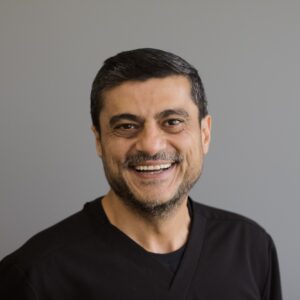
In our clinic all three steps happen under one roof. Dr. Hisham Badawi, a specialist orthodontist who originated OSIM, a 3D orthodontic force simulator, writes the plan. Planning support includes machine-learning clinical decision support, with the clinician in the loop as the sole author of every prescription. The printing and finishing happen in our own lab at the clinic.
Why keeping the whole process together matters
Teeth are living tissue, and they do not always follow a plan exactly. The research is clear that adjustments are a normal part of aligner treatment:
- Planned and achieved movements differ. A 2020 study of 38 patients treated with one widely used aligner system found that teeth reached, on average, 50% of the movement planned for them. Turning movements were the least accurate, at 46% (Haouili et al., American Journal of Orthodontics and Dentofacial Orthopedics).
- Almost every patient needs a revised plan. A 2023 study of 324 patients from 11 orthodontists found that 99.4% needed at least one refinement phase, with a median of two revised plans per patient. The revisions added 8,452 aligners to the 9,135 in the original plans (Meade et al., Journal of Orthodontics).
In other words, the first plan is a starting point. What shapes the final result is how well each revision is diagnosed, designed and made. When the same clinician plans the movement, sees how the teeth responded and controls how the next trays are made, every revision is guided by the same diagnosis and the same understanding of the forces involved.
What it means for you
- One team accountable for the result. The orthodontist who examines you is the one who designs your plan and oversees how your aligners are made.
- Revisions planned by the person who knows your case. When teeth need a new plan, the changes come from the same diagnosis, made at the same clinic.
- The right tool, not a fixed product. Because we design our own treatment, aligners are one tool among several. Some cases need attachments, some do better with braces, and the consultation decides.
- One treatment fee. It covers whatever your treatment needs, braces included if they become necessary, with no itemized charges. Treatment is limited to 36 months and depends on your cooperation.
Clear Aligners for Adults describes adult treatment in more detail.
Questions to ask any provider
Wherever you are treated, these questions show how your aligners will be made:
- Who designs my treatment plan, and what training do they have?
- Where are my aligners made, and who checks them before they reach me?
- If my teeth do not follow the plan, who decides the changes, and how long does a new set take?
- Is the fee the same if I need revised aligners, or braces?
- Will an orthodontist see me at my check-ins?
Clear answers to each of these tell you who is responsible for your result at every step.
Meet the team that makes your aligners
Your first visit is 60 minutes at our NW Calgary office, where Dr. Badawi examines your teeth and bite and explains your options. Book a consultation.
References
- Haouili N, Kravitz ND, Vaid NR, Ferguson DJ, Makki L. Has Invisalign improved? A prospective follow-up study on the efficacy of tooth movement with Invisalign. American Journal of Orthodontics and Dentofacial Orthopedics. 2020. doi:10.1016/j.ajodo.2019.12.015.
- Meade MJ, Ng E, Weir T. Digital treatment planning and clear aligner therapy: a retrospective cohort study. Journal of Orthodontics. 2023;50(4):361-366.
Related: Orthodontist in NW Calgary