
By Dr. Hisham Badawi, Orthodontist (certified specialist), BDS, DDS, MOrth, PhD, FRCD(C). About Dr. Badawi
When aligners “stop tracking,” the plastic is asking a tooth to do something the forces can’t deliver. More aligners or another refinement scan rarely fix that on their own. A better force plan does.
How a tooth actually moves
Each tooth sits in the jawbone, held by a thin cushion of ligament. A gentle, steady push squeezes the ligament on one side and stretches it on the other. Your body responds by slowly removing bone where it is squeezed and adding bone where it is stretched. The tooth moves with it, a fraction of a millimetre at a time.
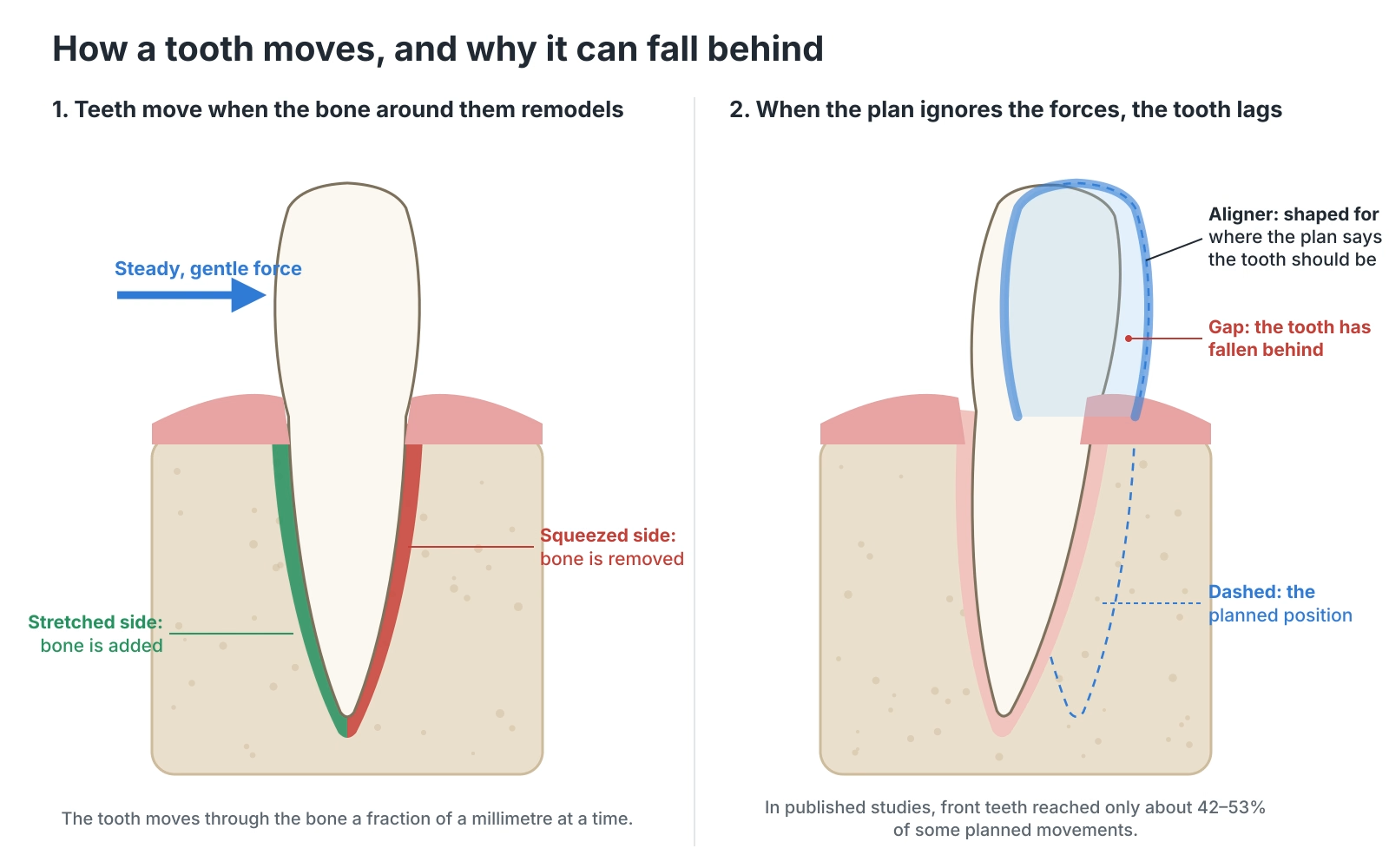
Left: how bone remodels as a tooth moves. Right: when the plan ignores the forces, the tooth tips and lags behind the aligner.
An aligner is simply a mould of your teeth with each tooth nudged slightly toward its goal. The plastic flexes when you put it on, and as it springs back it pushes. That push is the whole treatment.
Why the push sometimes misses
Many aligner plans are made by drawing where the teeth start and where they should finish, and then letting software fill in the steps between. It is like drawing a straight line across a map without checking for mountains. The software treats each tooth as if it floats freely in space.
Real teeth don’t float. Their roots sit in bone, and they touch their neighbours. A push on one tooth spreads to the teeth beside it, and part of that push goes where nobody wanted it. Dr. Badawi calls these wanted and unwanted forces.
When the plan ignores this, the teeth fall behind the plastic. Published studies show how big the gap can be. In one, front teeth reached only about 42% of the root angle that was planned. In another, they reached about 53% of the planned tilt. A 2025 consensus of 36 international aligner experts agreed that some movements, such as moving back molars more than 1.5 mm, are simply not effective with aligners alone.
Signs your aligners are not tracking
- A visible gap between the aligner and the edge of a tooth
- A new tray that won’t seat fully, even after a day or two
- Being told you need “refinements” again and again
What fixes it
The fix starts before the first aligner is made. The force system is designed first, and the steps come second:
- Each tooth’s movement is planned in all six directions it can move, including tipping and rotating, not just sliding.
- The steps respect how far each tooth can travel per aligner, and which teeth should move together or one after another. Dr. Badawi calls this simultaneous versus sequential mechanics.
- The plan accounts for how a push on one tooth affects its neighbours, which Dr. Badawi calls force propagation.
This is the approach behind the aligners designed and made in our own clinic. Dr. Badawi authors every movement himself. Machine-learning tools support his decisions, but he remains the sole author of every prescription. In our own review of completed cases (one clinic, looking back at past cases, not yet peer-reviewed, and the two groups were not matched case by case), patients used a median of 100% of the aligners planned for them, compared with 86% under the outsourced system we used before (see how we measure our results).
If your aligners have stopped tracking
Don’t skip ahead to the next tray or force a tray that won’t fit. Call the office that is treating you. If you would like a second opinion, we look at the forces behind the plan, not just a new scan.
Quick answers
- Is it my fault? Sometimes. Aligners only push while you wear them, so follow your wear schedule. But a plan that asks for impossible movements will stall even with perfect wear.
- Will another refinement fix it? Only if the new plan changes the forces. Repeating the same plan tends to repeat the same result.
Related reading: How Teeth Actually Move: The Biomechanics Behind Every Aligner
Related: Second opinion on your aligner treatment · Clear aligners for adults
