Both family dentists and orthodontists in Canada can offer clear aligners. The difference lies in training: an orthodontist has completed two to three more years of full-time university study devoted entirely to how teeth and jaws move. That training matters most in the part of treatment you never see, which is the plan.
Same plastic, different plan
A clear aligner is a thin, removable tray. Each tray in a series is shaped slightly differently from the last, and each one presses on the teeth with a small, steady force. Over weeks, the bone around each tooth remodels and the tooth moves.
The trays themselves are the easy part. The hard part is deciding which teeth should move, in what order, by how much, with what force and for how long. Most important of all is why: every movement should answer a diagnosis of the bite, the jaws and the face, not simply line the teeth up on a screen.
Planning software will show almost any movement you ask of it. On screen, the possible sequences are practically endless, and every one of them looks convincing, but many cannot be achieved in the mouth. Teeth do not move like beads on a string: push one, and its neighbours, its root and the bone around it all respond. A good plan respects the physics and the biology of your mouth, and finding it takes careful diagnosis and planning.
When the plan fits the physics, the teeth move where they were meant to. When it does not, the teeth can meet resistance on the way to a position they cannot reach, and corrections tend to build on one another: more enamel filed between the teeth, more aligners, more attachments, more hours of wear, more elastics and more refinement stages. In the 2020 study described below, teeth reached on average about half of the planned movement.
A treatment plan is not a graphic on a screen. Every change to a plan is felt by a person, often a child. That is why, at Smile Elements, each plan is set by the orthodontist who examines the patient.
What the research shows
Published research shows how wide the gap between screen and mouth can be. In a 2020 study in the American Journal of Orthodontics and Dentofacial Orthopedics, teeth moved on average about half as far as planned (50%, across 38 patients treated with a widely used aligner system). Some movements fell further short, reaching only about a third of the plan.
A 2019 review of eight studies in BMC Oral Health found both aligners and braces effective overall, and aligner treatment was shorter on average. Aligners were weaker, however, at bringing the teeth into good biting contact, controlling the tilt of the roots, widening the arches, and holding the result afterwards.
That gap is why planning matters so much. A plan built on how teeth actually move narrows the gap from the start, rather than closing it later with extra trays.
This is the field orthodontists train in. Its proper name is orthodontic biomechanics: the physics of forces on teeth.
What an orthodontist's training adds
Every orthodontist in Canada is a dentist first. After four years of dental school, an orthodontist completes an accredited two-to-three-year university program in orthodontics, according to the Canadian Association of Orthodontists. That program covers growth and development of the face and jaws, biomechanics, and diagnosis of how the teeth, jaws and airway fit together.
Orthodontists can then sit the national specialty examination of the Royal College of Dentists of Canada; those who pass hold the title FRCD(C). Only dentists with this specialty education can present themselves as orthodontic specialists.
In practice, that training shows up in three places:
- Diagnosis. Many crowded smiles are a jaw-size or bite problem, not a straightening problem. Diagnosis decides whether aligners alone can do the job, or whether something else is needed.
- Force planning. Some tooth movements are routine for aligners. Others, such as rotating a rounded tooth, moving a tooth upward, or closing a large space, take careful planning to achieve.
- Course correction. When a tooth falls behind the plan, the cause is usually mechanical. Reading that early keeps treatment on track.
Your family dentist is part of the team
This is not a choice between your dentist and an orthodontist. Your family dentist keeps your teeth and gums healthy before, during and after treatment, and is often the first to notice that orthodontic care could help. Many patients come to us on their dentist's referral, and we write back to the referring office after each consultation with our findings and recommended plan.
A good rule of thumb: if your dentist suggests straightening, ask whether your case is simple or complex. Simple cases can go well in either setting. When the bite is involved, or when a child's jaws are still growing, an orthodontist's assessment is worth having.
How we plan treatment at Smile Elements
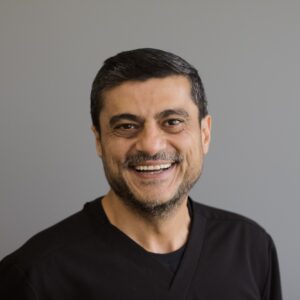
Our practice is built around biomechanics. Dr. Badawi holds a PhD in orthodontic biomechanics from the University of Alberta, where he developed OSIM, a 3D simulator of the forces orthodontic appliances apply to teeth. That work shapes how every case here is planned.
- We design and make our aligners in our Calgary clinic. The orthodontist who examines you plans your treatment, and our own team fabricates the trays.
- Our protocol is designed to avoid attachments, the small tooth-coloured bumps bonded to teeth in many aligner systems, and to keep tooth filing to a minimum.
- Machine-learning clinical decision support informs each plan, with the orthodontist in the loop as the sole author of every prescription.
Questions to ask any provider
Whoever you choose, these questions help you compare:
- Who examines me, and who designs the plan?
- Is my case simple or complex, and why?
- What will you do if a tooth does not move as planned?
- Will I need attachments or tooth filing?
- What happens after treatment to keep my teeth in place?
Book a consultation
If you are considering clear aligners, a consultation gives you a diagnosis and a clear picture of your options. Book a consultation at our NW Calgary clinic, or ask your family dentist for a referral.
Related: Clear aligners for adults · Clear aligners for children and teens · About Dr. Badawi
Related: Orthodontist in NW Calgary · Second opinion on your aligner treatment