
By Dr. Hisham Badawi, Orthodontist (certified specialist), BDS, DDS, MOrth, PhD, FRCD(C). About Dr. Badawi
Your aligner plan is a prescription: it decides which teeth move, in what order, how far, and whether any enamel is removed. Most patients assume their orthodontist designs it from start to finish. In practice, that rarely happens.
How conventional aligner plans are usually made
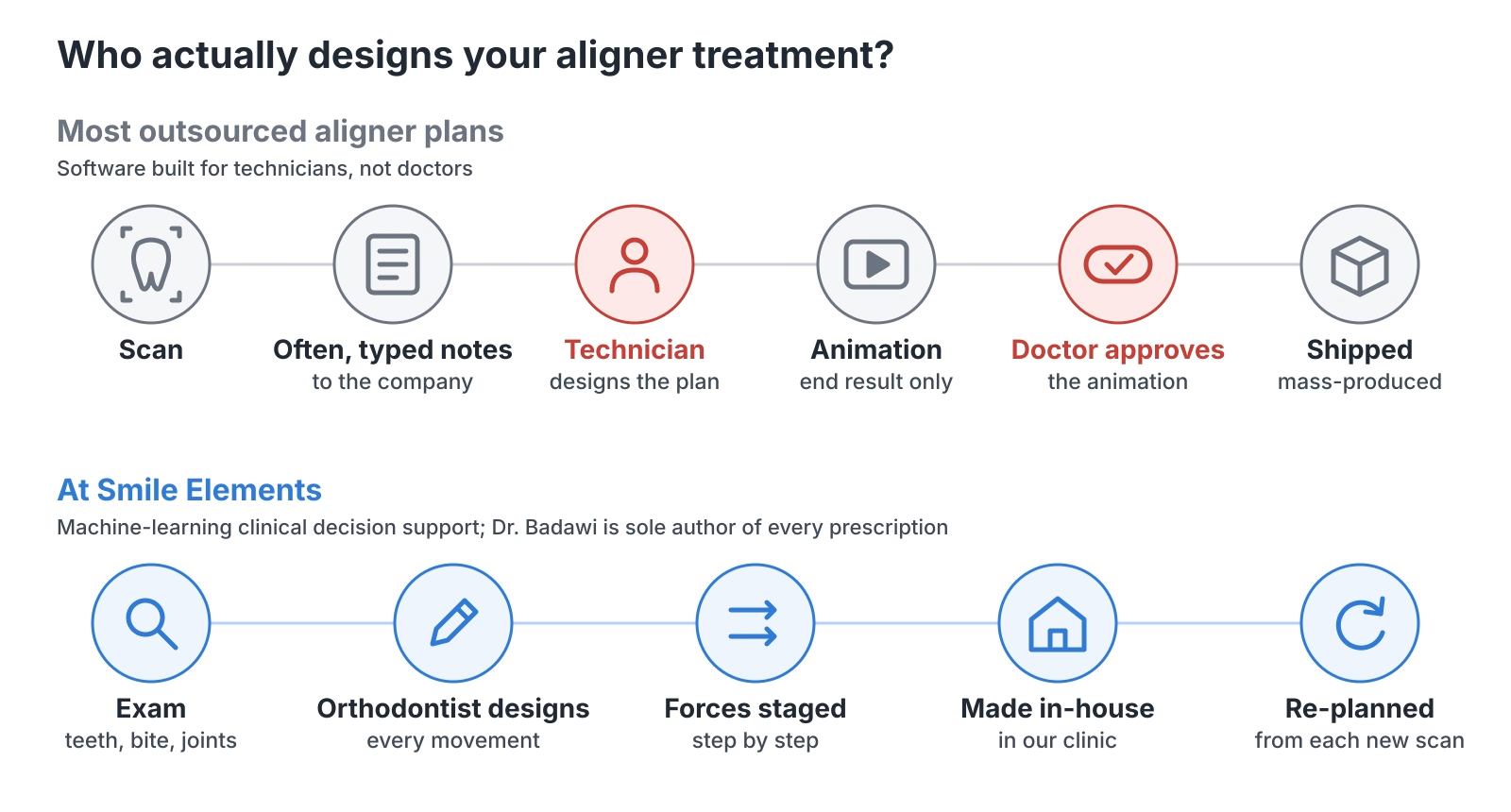
Aligner companies give orthodontists software that could, in principle, be used to design a plan tooth by tooth. In Dr. Badawi’s experience, very few doctors build the movement plan themselves from start to finish. That isn’t because doctors don’t want to. The planning software was built for technicians, not clinicians, because that is how the industry grew up. Even orthodontists who make aligners in their own clinics have to work with tools that were never designed for doctors. Instead, the doctor usually types instructions into a text box. A setup technician at the company’s planning centre then builds the plan: the order of movements, the number of aligners, any bumps glued to the teeth and any enamel shaving. The technician also makes an animation of the result. The doctor reviews the animation, may ask for changes, and clicks approve.
Your doctor is legally responsible for the plan they approve. But approving an animation is not the same as designing the forces behind it. An animation shows where the teeth should end up; it doesn’t show whether the forces can actually get them there.
When treatment runs long or has to be redone, patients and their doctors both pay the price.
How we do it
At Smile Elements, Dr. Badawi designs every tooth movement himself. He plans each tooth in all six directions it can move, sets the steps, and supervises the making of each aligner in our own clinic. Machine-learning tools support his decisions, but he is the sole author of every prescription.
That approach comes from his research. During his PhD at the University of Alberta, Dr. Badawi built OSIM, a laboratory model of the human mouth with 14 force sensors that measured the forces on every tooth in the arch. It measured those forces with an error of about 1.5%. The work was published in the American Journal of Orthodontics and Dentofacial Orthopedics in 2009. It showed, for example, that two common ways of holding a wire in braces put very different forces on the same teeth. Understanding the real forces, rather than assuming them, is the idea his aligner plans are built on.
Five questions to ask any orthodontist
- Who designs my tooth movements: you, or a technician?
- Can you change how the plan works, or only approve it?
- Will my teeth need shaving or glued-on bumps, and why?
- How many aligners are planned, and how many do your patients usually end up using?
- How does the plan take my bite and jaw joints into account?
Good answers to these questions tell you a lot about how your treatment will be planned.
Related: Clear aligners for adults · Second opinion on your aligner treatment
